
The Still Lifes of Gabriele Münter

Updated: Jul 27
Gabriele Münter (1877–1962) is best known as a German Expressionist artist. Together with Wassily Kandinsky, who was her partner at the time, she was a founding member of The Blue Rider Movement—a short-lived but vital collective that laid the groundwork for German Expressionism (1911–1914). These artists heralded the importance of color and form to express their inner thoughts, explore spirituality, and convey powerful emotions like anxiety and love.

Still Life on the Tramway (After Shopping), c. 1909–1912
Münter demonstrates her distinct originality by transforming a fleeting, everyday scene into a temporary still life—one that will completely come undone the moment the passenger stands up. This sense of a structured still life is reinforced both by the potted flowers held in the woman's hands and the matching flower motif on her purse. Furthermore, Münter's deliberate choice to crop the figure focuses our attention entirely on the accidental arrangement created on the woman’s lap.

Still Life with Mirror, 1913
In this highly modern composition, Münter uses a mirror to frame an intimate still life composed of a jewelry box resting on top of a dresser. Curiously, the frames hanging on the background wall are depicted either entirely empty or containing blurry, indistinct figures. A pillow resting on the bed is also incorporated into the composition, while bold colors are used to give depth and perspective to the scene. Most notably, the mirror attached to the jewelry box reflects back to the viewer what appears to be an elongated image of the artist herself.
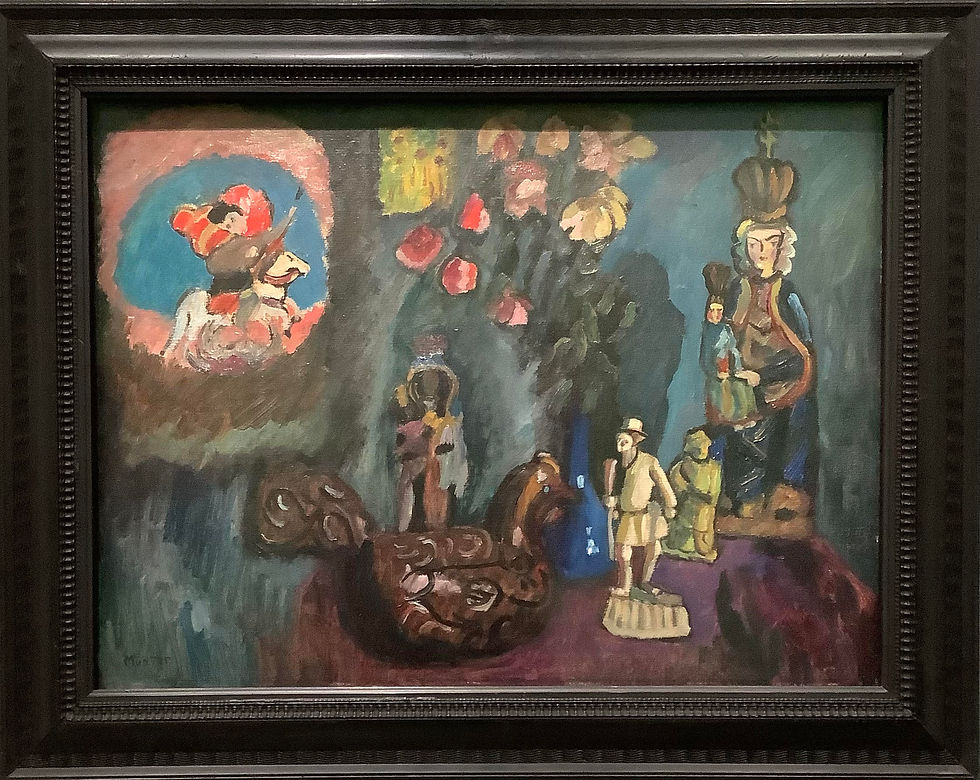
Still Life with Saint George, 1911
This still life depicts a selection of objects from Münter’s personal folk art collection laid out across a tabletop. While some items are rendered with clear definition, others are heavily blurred, rendering them virtually unidentifiable. In the background, a blue vase filled with flowers can be discerned. Towering over the rest of the arrangement, Saint George on his horse seems to float above the composition, emanating a brilliant light that pierces through an otherwise dark and somber scene.

Pentecost Still Life II, 1934
This work is part of a series of paintings that employs a folk-art approach to represent the Christian subject of the Holy Spirit. Here, the carving of the dove is positioned on its back with its legs turned upward, giving the striking impression that it is dead. Behind the dove, a ceramic plate features circular decorations that could be interpreted as a traditional halo, though in effect, they closely resemble an archery target. The flowers in the vase appear wilted and dry; the only living components of the entire composition are the fruits scattered in the foreground. Münter painted this bleak scene at a harrowing moment in history—just as Germany witnessed the rise of Hitler to supreme power, the violent purge of political rivals, and the implementation of antisemitic laws that cemented totalitarian rule.

Still Life with Red Cutlery, 1930
Münter explained the spontaneous origin of this painting in a letter to her partner, Johannes Eichner:
"Last night, I wanted to write cards and letters, as I had intended to do for some time—doing a little sewing would have been just as good—but instead, I painted a still life that I spotted while clearing the table. Red cutlery in a white bowl (and a lemon) with the shadows they cast."
While no figures are physically present, the serving utensils resting in the bowl and the empty chair standing in the background strongly imply a human presence. Much like a cropped photograph, the composition zooms in precisely on the everyday elements the artist wished to feature.

Breakfast of the Birds, 1934
This work is not a still life in the traditional sense, yet the tabletop arrangement serves as a major component of this reflective self-portrait. As the lone figure looks out her window at the birds, the viewer's eyes are drawn to the objects laid out before her: a coffee pot, a milk pitcher, and a plate on one side, balanced by cakes set out on the other. These carefully positioned elements bring a quiet sense of normalcy to an otherwise melancholic and solitary composition.

Still Life in front of The Yellow House, 1953
In this composition, Münter places a vibrant still life directly in front of a landscape painting, which happens to be a reproduction of one of her own 1911 works. By doing so, she masterfully incorporates two different genres into a single canvas. The background landscape projects the dark, heavy colors of winter, while the foreground still life—composed of fruit and flowers—radiates a warm spring light.
The images of these works were taken at the show Gabriele Münter: Painting to the Point at Musée d'Art Moderne de Paris which ran from April 4 to August 24, 2025.


Comments