
An Art Journey: Rome & Venice Oct. 2018

Updated: Jul 27

Just back from Roma and Venezia. I am going to share with you the amazing shows and places we saw. My advice to you? Next time you travel to Europe, throw away the guidebook and follow your heart. It will lead you to see what will resonate and enrich your life. (Photo by Sherry Fyman of artist Rossella BLUE Mocerino at Hotel Raffaello in Roma)

My Roman Holiday starts with the Je suis l'autre art show at Terme di Diocleziano. Modern sculptures are placed alongside their sources of inspiration—works from other cultures—with thrilling results. None of us live in a vacuum, and none of us are better than others. It is a necessary show for our troubling times.

I got it wrong. I assumed the large sculpture was Western, but it is actually from 19th-century Oceania, while the smaller sculpture is by the 20th-century British sculptor Kenneth Armitage.


I never would have guessed that the sculpture on the left is by Joan Miró and the one on the right is by Max Ernst—both 20th-century Western artists.

This sculpture is by one of my favorite 20th-century sculptors, Marino Marini. He was highly influenced by Etruscan art—the Etruscans lived in central Italy during the 3rd century BCE.

The Je suis l’autre art show is an example of a beautifully curated collection in a breathtaking space. I like the plexiglass cases that allow us to view the works on display while catching a glimpse of ourselves and other visitors interacting with them. The work in color is by 20th-century sculptor Jean Dubuffet. (Photo by Sherry Fyman)


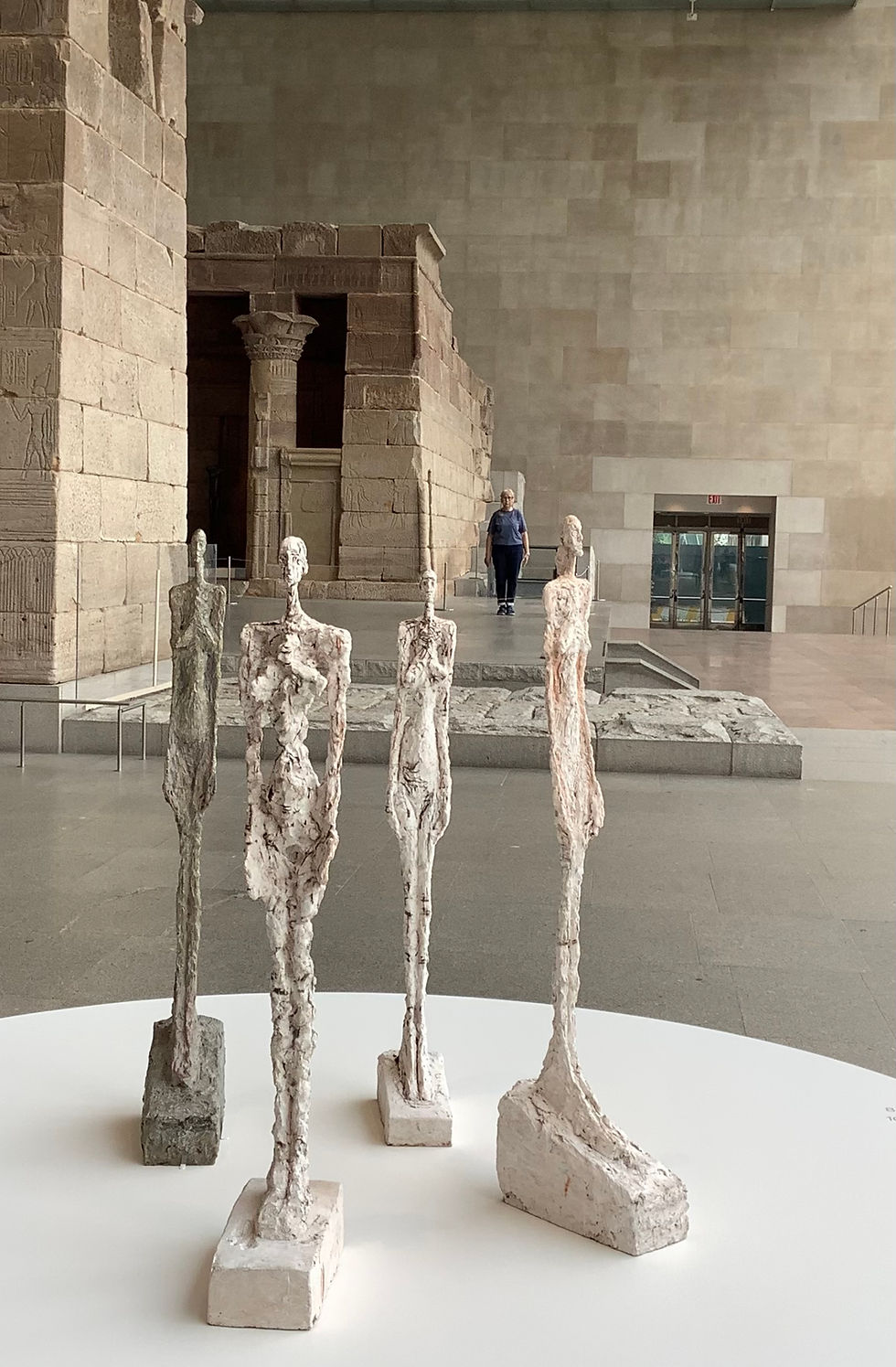
Western artists have been—and continue to be—profoundly influenced by artists from other cultures. Left: A 20th-century work by Alberto Giacometti. Right: A late 19th-century sculpture by an artist from Oceania.
Roma is a beautiful city, but sometimes you want to get away from the crowds. I suggest a walk through the Coppedè district, where you will find peace, quiet, and extraordinary Art Nouveau buildings in the Stile Liberty. Don't forget to look up and notice the intricate reliefs on the facades.


I am fascinated by how shadows define a space. Here is the Mausoleo di Santa Costanza, Roma.

I was over the moon when, strolling through the collection at Palazzo Doria Pamphilj, I came across the portrait of Pope Innocent X by Velázquez. This is the very painting that obsessed Francis Bacon and inspired his iconic Pope series.


Villa Giulia houses an excellent collection of Etruscan art. Don’t these figurines on the left, dating from the 3rd century BCE, bring to mind the work of 20th-century sculptor Alberto Giacometti on the right?


Considering all that women have had to put up with through the centuries, I would like to share these statuettes of the Goddess Minerva in battle. (Etruscan Art, Villa Giulia, Roma)

This concludes the Roma part of the trip—see you next in Venezia!
The Architecture Biennale is currently on in Venice, and I went to see the homage to Renzo Piano. While I am generally not fond of his massive projects that disrupt the landscape, there is one design of his I truly admire: the pulley system he created for the Emilio Vedova Museum in Venice, which rotates the artwork so nothing remains hidden in storage.


Good Fences Make Good Neighbors: Arch / Good Fences Make Good Neighbors — or Gilded Cage — by Ai Weiwei in the courtyard of Palazzo Franchetti. This temporary exhibit, which was also shown in New York, addresses the growing hostility toward immigrants, the global rise of nationalism, and the expanding refugee crisis. Notice in the background the beautifully executed restoration of the Accademia Bridge in Venezia.

The Peggy Guggenheim Collection in Venice features a permanent collection alongside one or two temporary exhibitions. Here I am at the Osvaldo Licini exhibition. (Photo by Sherry Fyman)

Since I found myself at the Peggy Guggenheim Collection in Venice, I thought I would go see my favorite Modigliani in their permanent collection. Alas, they had just put it in storage. I'm so lucky I got to see it on my previous visit to Venice—one never knows when, or if, a painting will come back out of storage.

Going to Venice is always a deeply personal journey for me. On this 43rd visit, I went to Palazzo Fortuny to see the exhibition on the painter Zoran Mušič. Back in 2010, when I was exhibiting in Venice, a show of his work was running at the exact same time—throughout the city, our exhibition posters hung side by side.

At the current Zoran Mušič exhibition at Palazzo Fortuny, I came across this photograph of him in his Venice studio with his cats. I am awestruck that a man who survived and was liberated from a concentration camp by the Allies could have such a wonderful, warm smile. He bore witness to the atrocities of the camp by secretly documenting what he saw in drawings.

Another 20th-century Italian sculptor I like very much is Adolfo Wildt. Here is an example of his work from The Collezione Merlini at Palazzo Fortuny. Look at the shadows the relief creates—as far as I am concerned, they are an integral part of the work itself.

Idols: The Power of the Image is a must-see exhibition running through January 2019 at Palazzo Loredan in Campo Santo Stefano, Venezia. Shown here are two works from Mesopotamia dating to 2500 BCE.

The Cyclades are an island group in the Aegean Sea, southeast of mainland Greece. Here are some representations of their art from 2500 BCE, seen at the Idols exhibition at Palazzo Loredan. These Cycladic figures highly influenced the work of Amedeo Modigliani.


So, my October 2018 trip to Roma and Venezia has come to an end—but not for long! I will be back in Venezia during Carnevale 2019 for my work. I feel like a bit more of an honorary Venetian with my new library card to the Biblioteca Marciana in Piazza San Marco.



Comments