
Guest Writer: Sherry Fyman 'Giacometti's Women in the Temple of Dendur'

Updated: Aug 10
There’s a current exhibit at the Metropolitan Museum of Art, Giacometti in the Temple of Dendur. I admire Giacometti’s work and have seen his reconstructed studio at the Foundation Giacometti in Paris so I was quite interested to see what his sculptures would look like placed against the backdrop of ancient Egypt. Would this just be a gimmick?


You might think that placing Giacometti’s razor-thin figures beside the massive stone blocks of the Temple of Dendur would make them seem fragile, as if they might simply blow away. Instead, the opposite happens. They appear all the more rooted, resilient, and enduring.
The Giacometti sculptures chosen for the exhibition are all women, and that is what makes the setting feel like an authentic dialogue rather than a clever curatorial conceit. They seem less like visitors to the temple than figures who have quietly emerged from it, carrying its stillness and dignity into the modern world. The women seem to bridge three thousand years of history, suggesting that what Giacometti sought in the aftermath of the war was not so different from what Egyptian sculptors sought millennia earlier; the enduring presence of the human spirit.

By stripping away excess flesh, muscle, and individual identity, Giacometti reduced the human form to its bare essentials. His figures often stand alone on heavy bases, emphasizing both their isolation and the vast emptiness that surrounds them.
Seen alongside the Museum’s Ancient Egyptian sculptures, however, they evoke something quite different. Rather than emphasizing distance between past and present, they reveal a remarkable continuity. The elongated, austere figures carved by Egyptian artists more than three thousand years ago seem unexpectedly akin to Giacometti’s postwar men and women—and, in turn, to the people I pass every day on the streets of Manhattan.

The exhibition also changes the way I see the Egyptian sculptures themselves. No longer do I walk past them as relics of a remote civilization populated by people fundamentally unlike us. Instead, they become recognizably human. Across three millennia, Giacometti reminds us that while clothing, customs, and civilizations change, the essential human presence remains astonishingly constant.
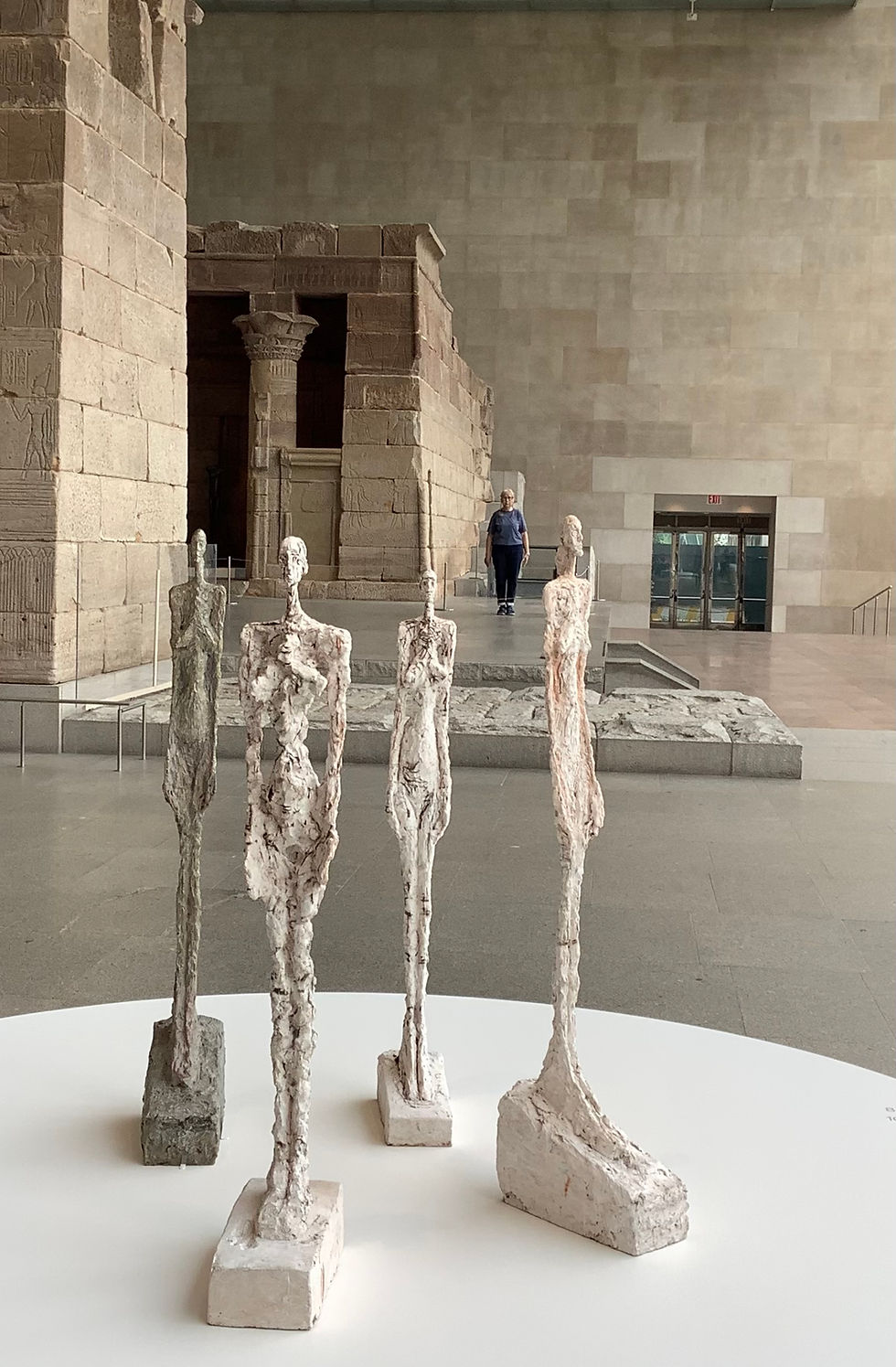
Giacometti in the Temple of Dendur continues at the Metropolitan Museum of Art in New York City through September 8, 2026. All photos by Sherry Fyman, author of this post.


Comments