
Abstract Art is Out Depicting the Human Figure is Back

Updated: Jul 27

In the summer of 2018, returning from a trip to Edinburgh and London, I was struck by a common thread running through every exhibition I visited: a deep focus on humanity. In this post, I want to share how the featured artists in these shows perceive and portray the human condition. (Featured here: the poster for the "All Too Human" exhibition at Tate Britain.)

My itinerary began with Rembrandt’s Britain at the National Galleries of Scotland in Edinburgh. (Photo by Sherry Fyman.)

Rembrandt's An Old Woman Reading (1655). Notice how her head covering isolates her from the external world, while the firm grip of her hands underscores her intense concentration. The light illuminating her face seems to emanate from the pages of the book itself. Though advanced in years, she reminds us that there is always more to discover and learn.

Rembrandt’s A Woman Bathing in a Stream (1654). At first glance, this scene appears idyllic, yet the background carries a subtle ominous weight with its dark, reddish tones. Could this fleeting moment in the water be merely a brief respite from a hard and uncertain life?

Glenn Brown, Piaceri Sconosciuti (Unknown Pleasures), 2016. British artist Glenn Brown frequently begins with an Old Master's work—in this case, a Rembrandt—appropriating and reinterpreting it to create something uniquely his own.

Walking through the National Gallery of Modern Art in Edinburgh, I came across Aleppo (2017–2018) by British artist Jenny Saville. Executed in pastel and charcoal on canvas, its composition draws on Michelangelo’s Pietà to build a monument to contemporary conflict, immense human suffering, and devastation.

Next stop on the itinerary: Frida Kahlo: Making Her Self Up at the V&A in London. (Depicted here: one of the posters for the exhibition.)

Frida Kahlo, Self-Portrait (1943). Kahlo endured a life of constant pain, bound by corsets and leg braces, yet she managed to forge an elegant, unique, and iconic presence. Her work remains a profound lesson in dignity and the endurance of the human spirit.

Next stop on the itinerary: Tate Britain for the exhibition All Too Human. (Photo by Sherry Fyman.)

Francis Bacon, Study after Velazquez (1950). Bacon was obsessed with Velázquez’s portrait of Pope Innocent X, creating numerous variations on the motif. In Bacon’s hand, the Pope is consistently isolated and screaming; here, stripped of his clerical vestments and clad in a modern suit, he appears as a symbol of raw power and corruption.

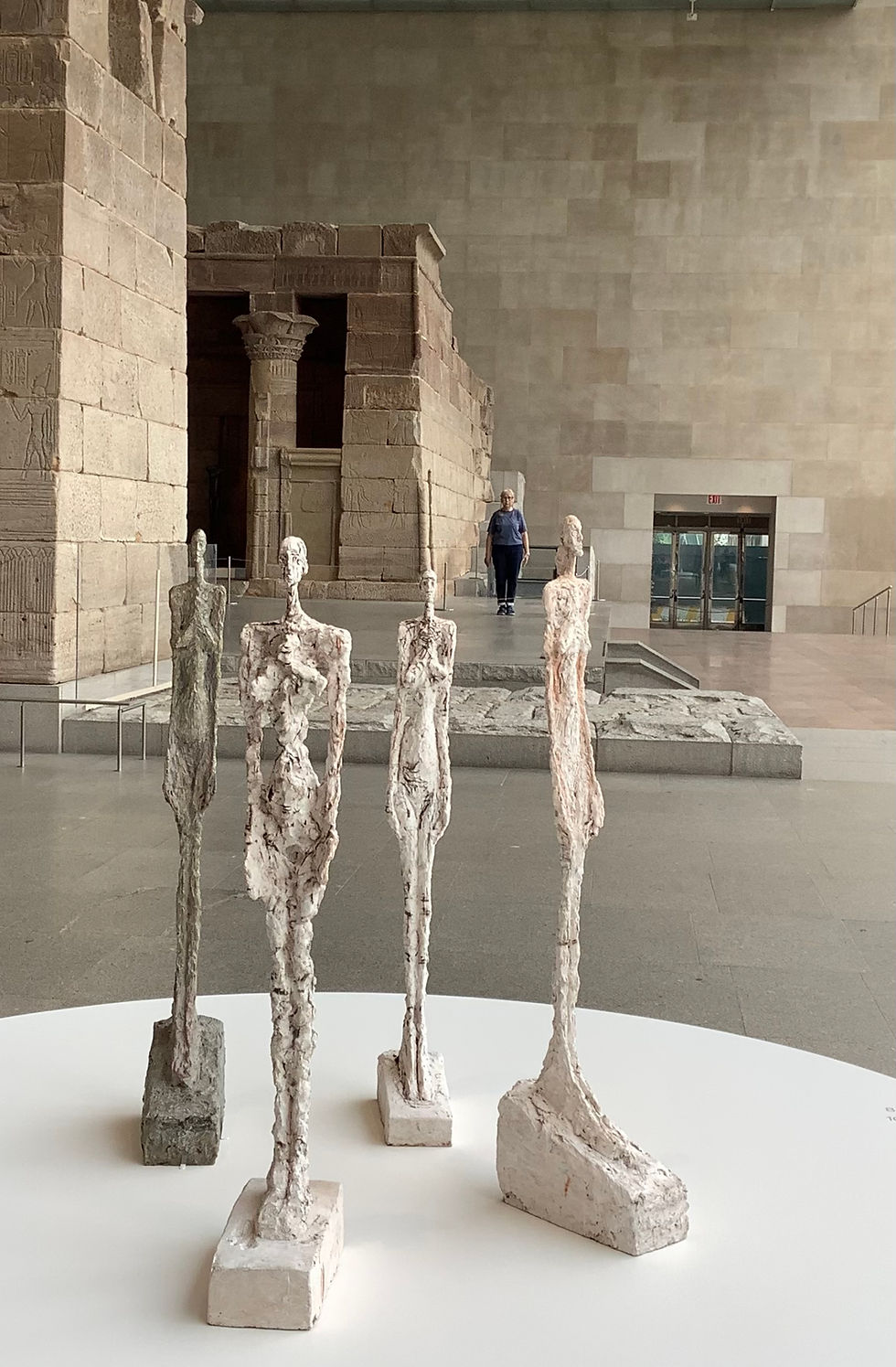
Alberto Giacometti, Woman of Venice IX (1956). Giacometti’s tall, slender figures capture the human form as perceived from a distance. The artist explained that larger, life-sized figures felt "false" to him—only when sculpted as elongated and slender did they feel true to his vision of humanity. (Photo by Sherry Fyman.)

Lucian Freud, Sleeping by the Lion Carpet (1996). While many artists work in the seclusion of their studios, Freud stood apart by making his studio environment—and everything within it—an integral part of his paintings.

Francis Bacon, Triptych May–June 1973 (or Triptych 1974–1977). (From the exhibition label: This is Bacon’s final triptych addressing the tragic loss of his former lover George Dyer, who took his own life in 1971.)

Paula Rego, In the Company of Women. If women were portrayed in these poses, we might not think twice about it—yet swap the women for men, and it becomes striking how rarely men are ever depicted this way.

Paula Rego, The Family. Is the underlying power dynamic made clearer if we imagine replacing the central figure of the woman with a man?

Jenny Saville, Reverse (2002–2003). Saville avoids working from live models in favor of photographs, drawing heavily on medical textbooks to collect images of burns and bruises. Depicted here is a monumental close-up self-portrait.

Next and final stop on the itinerary: Picasso 1932 at Tate Modern, London. (Photo by Sherry Fyman.)

Pablo Picasso, The Rescue (1932). (From the exhibition label: Toward the end of the year, Picasso turned to a new and darker subject matter—the threat of drowning and the possibility of rescue.)

"I will never make art with the preconceived idea of serving the interests of the political, religious, or military art of a country." — Pablo Picasso

Pablo Picasso, The Rescue (1933). Europe was in shambles—Hitler and Mussolini were solidifying their bases, Spain was engaging in a civil war, and soon there would be another war. The agony of the mother and child in this painting, the gray sky, the isolation of the figures . . . I can’t stop crying.

The Picasso 1932 exhibition ends with this quote by Michel Leiris: “Everything we love is about to die, and that is why everything we love must be summed up, with all the high emotion of farewell, in something so beautiful we shall never forget it.” Shown here: The Sculptor by Pablo Picasso.

This painting of mine, entitled "With Love," lives in London in a private collection. I went to visit my painting a few years back, and that's how I discovered London.


Comments